

Assess for success
implementing the complete assessment cycle from Cambridge
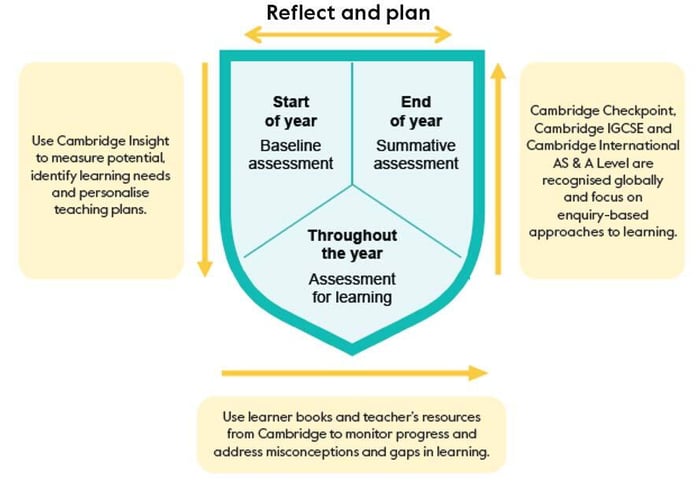
Cambridge offers a unique range of assessment tools that can empower teachers and learners to unlock potential. The complete assessment cycle framework from Cambridge is an evidence-based approach that we recommend to schools that aspire to make a measurable difference to learner outcomes. What’s the secret ingredient to this recipe for success? Start with a baseline.
Start with a baseline
Cambridge Insight baseline assessments measure the core skills and aptitudes that our research shows are critical for accessing any curriculum: reading, vocabulary, mathematics and cognitive abilities like reasoning, problem-solving, perception and decision-making.
Cambridge Insight gives you instant insight into what your students already know and can do as they enter a new learning stage, while supporting you in deciding the best next steps for teaching and learning. Our baseline assessments are digital, adaptive and require no teacher marking – reports are generated instantly.
Develop with assessment for learning
Unlike a baseline assessment, formative assessments are designed to measure progress against a specific curriculum and its learning outcomes. Throughout the school year, assessments for learning are used to help learners understand their progress and help teachers know where to support and where to challenge learners. Comparing the baseline data with data from formative assessments allows you to easily spot if any learners are under or over performing.
Our resources provide lots of opportunities for assessments to enable learners and teachers to monitor progress and know where to focus. At Cambridge Primary and Lower Secondary stages of the curriculum, we provide progression tests to measure subject knowledge acquisition. They are great for tracking and reviewing your learners’ progress over time and will enable you to give structured feedback to learners and provide evidence of learning to parents and school leaders.
Succeed at summative
Using the data from baseline to inform teaching and learning, and the feedback from formative assessments to address misconceptions and gaps in learning, you are giving your learners the best chance to fulfil their potential in summative assessments.
Cambridge Checkpoint (at stages 6 and 9) is great preparation for Cambridge IGCSE. Checkpoint provides internationally benchmarked standardised scores and learners have the opportunity to practice test techniques and develop strategies to improve where needed.
Cambridge IGCSE and Cambridge International AS & A Level are globally recognised qualifications that encourage learner-centred and enquiry-based approaches to learning.
What does success look like?
We know that you consider a number of factors when thinking about how to measure the success of your school, your teaching and your students. Cambridge Insight baseline assessments can help you demonstrate more than just exam success. The data from baseline can provide answers to some critical questions.
Have my learners fulfilled their potential?
Without a baseline at the start of the learning stage, how would you know?
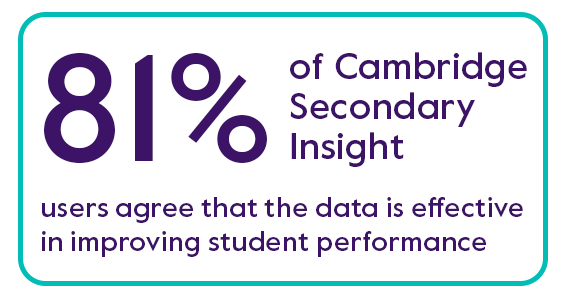
Our Cambridge Secondary Insight tools provide the unique chances reports for Cambridge IGCSE and Cambridge International AS & A Level, which show the learner’s chance of achieving every grade in each subject. Having this high quality, objective data from as early as age 11 is why 81% of Cambridge Secondary Insight users agree that the data is effective in improving student performance.
“We have found Cambridge Insight data helps us develop informed teaching and learning interventions before the start of each Cambridge course. This has led to better results in Cambridge exams.”
Jackline Aming’a, Head of School, Oshwal Academy Mombasa, Kenya
Has my school added value to my learners’ education?
Can you demonstrate that you have enabled your learners to achieve more than they might in another school? When results day comes along, the value-added report from Cambridge Insight shows the progress made from a baseline measure to an outcome measure such as Cambridge IGCSE or Cambridge International AS & A Level. It gives you an objective measure of where your learners have significantly over or under performed.
Is my school continuously improving?
The baseline data and value-added reports help you reflect and plan to support continuous improvement. The longitudinal data enables you to spot trends and demonstrate progress, allocate resources effectively and embed whole-school initiatives.
Reflect and plan
- Examine student outcomes
- Overall, what progress has been made?
- Is anyone under or overachieving compared to their baseline potential?
- What interventions did we implement and were they successful?
- What goals shall we set for the year ahead?
Implementing the complete assessment cycle from Cambridge means that learners can:
1 Fulfil their potential
2 Develop a growth mindset
3 Have skills for the future
And schools can:
1Provide personalised learning
2 Make a measurable difference
3 Continuously improve
By implementing the complete assessment cycle with Cambridge, be confident you have given your learners the best chance of success and supported them to be ready for the world!